James B. Lee Jr.
The King of Leveraged Finance
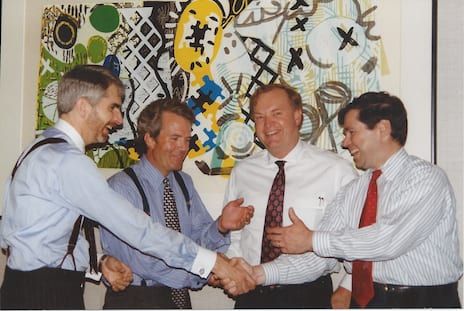
“If the financing is there, the deal happens. If the financing is not there, the deal does not happen. It is that simple.” Jimmy Lee
Jimmy Lee is the most important banker of the modern LBO era, and the one analysts least often study, because his work happened in syndicated-loan documents rather than tender-offer announcements. Felix Rohatyn, Bruce Wasserstein, and Joe Perella sold advice. Jimmy Lee sold money. For thirty years he sold more of it, more efficiently, to more important clients, than any banker on Wall Street.
He spent his entire career at a single institution, through three names: Chemical Bank, Chase Manhattan, and after the 2000 merger JPMorgan Chase. He started as a 23-year-old credit trainee in 1975 and rose to vice chairman of JPMorgan by 2009. He was Jamie Dimon’s closest senior adviser, the lead banker on virtually every mega-LBO of the 2006 to 2008 vintage, the architect of the Facebook IPO, and the man who personally helped engineer the 2008 rescue of Bear Stearns.
The Connecticut prep-school start
James Bainbridge Lee Jr. was born in New York City in 1952 and raised in Greenwich, Connecticut, the kind of suburb that produces Wall Street bankers the way Pittsburgh produces steelworkers. His father ran the New York office of a Boston brokerage. Jimmy attended Canterbury, a Catholic boarding school in Connecticut, then Williams College in Massachusetts, where he played hockey and football. He graduated in 1975 with a degree in economics. He did not have an MBA. He did not have any law training. He went straight to Chemical Bank as a credit-training analyst because his father had a contact there.
He spent the late 1970s and early 1980s in the standard credit roles at a mid-tier commercial bank: corporate lending, syndications, structured credit. By his early 30s he had identified what would become the defining product of his career: the syndicated leveraged loan.
Inventing the syndicated leveraged loan
The traditional bank-loan model in the 1970s and early 1980s was simple. A big corporate borrower would walk into a major bank (Citi, Bank of America, Chemical) and the bank would hold the entire loan on its own balance sheet. Risk concentration was massive. The loans were typically investment-grade and priced for very low margins. Sub-investment-grade lending was an afterthought.
Lee saw the opportunity. As the leveraged-buyout industry began to expand in the mid-1980s, KKR and Forstmann Little and the early Wesray transactions needed billions of dollars of debt that no single bank wanted to underwrite alone. Lee proposed that Chemical would lead-arrange the loan, take a chunk of it onto its own balance sheet, and syndicate the rest to a pool of other banks and institutional investors. The syndication desk would price the tranches, allocate the pieces, and handle the documentation.
By 1990 this was the dominant model for sub-investment-grade lending in the United States. Lee personally ran the leveraged finance group. By 1996, after the Chemical-Chase merger, his group was the largest syndicated-loan house in the world.
-
Structure 1
Senior secured term loan B
The institutional-investor tranche of a leveraged loan. Floating rate, callable, distributed to CLO managers and credit funds. Lee's group standardised the format that the entire global syndicated-loan market now uses.
-
Structure 2
Bridge loan to high-yield
The lead arranger commits to a short-term bridge that gets refinanced into a high-yield bond once the deal closes. Lets sponsors announce deals before the bond market is sounded.
-
Structure 3
Second lien and mezzanine
Subordinated tranches that sit between senior debt and equity. Critical to getting leverage ratios to 6x or 7x EBITDA on the largest 2006 to 2008 LBOs.
-
Structure 4
Pre-marketed underwriting
The lead arranger sounds out institutional investors before formally committing. Allows confident pricing on commitments that a single bank could never hold alone.
The 2006 to 2008 LBO peak
The years 2006 to 2008 were the peak of the leveraged-buyout cycle and Lee’s most visible period. Almost every mega-LBO of that vintage had JPMorgan as a lead arranger, with Lee personally on the phone. The list reads as the canon of late-cycle private equity:
- TXU (2007), $45 billion. KKR, TPG and Goldman. Lee led the $25 billion debt package.
- Equity Office Properties (2007), $39 billion. Blackstone. Lee lead-arranged the $29 billion debt.
- Hilton Hotels (2007), $26 billion. Blackstone.
- HCA (2006), $33 billion. KKR, Bain, Merrill Lynch.
- Harrah’s (2008), $30 billion. Apollo, TPG.
- Freescale Semiconductor (2006), $17.6 billion. Blackstone, Carlyle, Permira, TPG.
The cumulative debt his desk underwrote in 2006 and 2007 alone exceeded $400 billion. When the credit markets froze in the summer of 2007, JPMorgan was sitting on roughly $40 billion of bridge-loan commitments that no one wanted to buy. Lee personally negotiated the unwinds, the price talks, and the eventual losses, and walked the firm through the credit crunch with smaller realised losses than any of its peers.
Bear Stearns and the Facebook IPO
The weekend of 14 to 16 March 2008 is the most famous episode of Lee’s career. Bear Stearns was hours from collapse. The Federal Reserve was looking for an acquirer. Jamie Dimon, then CEO of JPMorgan, called Lee directly. Lee was the senior banker who negotiated the structural terms of the rescue: a $29 billion Federal Reserve guarantee on Bear’s hardest-to-value assets, in exchange for JPMorgan acquiring the firm at $2 a share (later raised to $10). The acquisition was announced on Sunday night. The financial system, by most accounts, survived in part because of how that weekend was structured.
Four years later, in 2012, Lee took on a different kind of mandate. JPMorgan was lead banker on the Facebook IPO. Mark Zuckerberg, then 27, was famously uninterested in road-show preparation. Lee spent weeks with him, walked him through the institutional-investor questions he would face, and personally accompanied him on much of the road show. The IPO itself had famous execution problems on NASDAQ but priced at $38 a share, valuing Facebook at $104 billion. Lee became Zuckerberg’s personal banker.
Lee's first principle of leveraged finance: the cheque comes first, the advice comes second. Sponsors hire the firm that will commit capital before the diligence is complete and the markets are tested. Confidence to underwrite is the entire franchise. Without it, you are a bond salesman.
The end
On 17 June 2015, Jimmy Lee left his Greenwich home for a workout. He returned to his garage afterwards and collapsed of cardiac arrest. He died en route to the hospital. He was 62. The funeral on 21 June was attended by Henry Kravis, David Rubenstein, Steve Schwarzman, Larry Fink, Jamie Dimon, and roughly every senior figure in American private equity. Dimon’s eulogy referred to him as ‘the irreplaceable banker’.
JPMorgan’s leveraged-finance franchise has remained number one in global league tables in every year since. The franchise Lee built has held. The 12 sponsors on his desk-side list are still mostly clients. The model is still the dominant model.
What to learn from Lee
For an analyst on the leveraged-finance desk, the Lee career is the most useful possible road map. He demonstrates the long-tenure path: build distribution, build relationships with sponsors, be available at three in the morning, never leave the institution. He also demonstrates that the financier sees the deal six months before the M&A adviser does. The cheque arrives first. The press release follows. That is the actual order of operations in private equity, and Lee ran it for thirty years.
Career timeline Key moments
- 1952 Born in New York City. Raised in Greenwich, Connecticut.
- 1975 Graduates Williams College. Joins Chemical Bank as a credit-training analyst. Never works for another firm.
- 1980s Builds the syndicated-loan business at Chemical Bank into the largest on Wall Street, displacing the traditional bank-loan structures used by Citi and Bank of America.
- 1993 Becomes head of all syndicated and leveraged finance at Chemical. Begins systematically targeting LBO sponsors as core clients.
- 1996 Chemical merges with Chase Manhattan. Lee runs the combined leveraged finance group.
- 2000 Chase merges with JPMorgan. Lee runs leveraged finance at the combined firm.
- 2004 JPMorgan acquires Bank One, Jamie Dimon's firm. Dimon becomes COO and then CEO. Lee becomes one of Dimon's closest senior advisers.
- 2007 Lead-arranges the $25 billion debt package for the $45 billion KKR-TPG-Goldman buyout of TXU, the largest LBO in history. Concurrently leads financing on the Blackstone-EOP deal ($39 billion).
- 2008 Plays a central role in the JPMorgan rescue of Bear Stearns. Lee personally negotiates much of the financing structure with Treasury and the Federal Reserve.
- 2009 Named vice chairman of JPMorgan Chase. The role is built around him: senior dealmaker, no operating responsibility, full discretion.
- 2012 Lead banker on the Facebook IPO. Personally manages Mark Zuckerberg's road show preparation.
- 2015 Dies suddenly on 17 June 2015 at age 62, of cardiac arrest after a workout. The industry stops for a week. Jamie Dimon delivers the eulogy.
In their own words Selected quotes
-
“If the financing is there, the deal happens. If the financing is not there, the deal does not happen. It is that simple.”
Jimmy Lee -
“There is no such thing as a small deal. Every transaction is a chance to build the next relationship.”
Jimmy Lee, in a 2010 interview -
“Markets close fast. The job of a leveraged finance banker is to commit before they do.”
Jimmy Lee, in client letters
Notable and surprising Things you might not know
- He never worked anywhere except Chemical Bank, Chase Manhattan, and JPMorgan Chase, the same institution through three names. He joined as a 23-year-old credit trainee in 1975 and was vice chairman 40 years later.
- He kept a printed list on his desk of the dozen most active private equity sponsors and made personal contact with someone at each of them every single business day for roughly 30 years. The list was the franchise.
- He lead-arranged or co-arranged the debt on Texas Utilities (2007), Hilton (2007), Equity Office Properties (2007), HCA (2006), Harrah's (2008), Freescale (2006) and virtually every other mega-LBO of the 2006 to 2008 era.
- He was the single most important figure inside JPMorgan during the 2008 weekend that rescued Bear Stearns. He helped structure the Federal Reserve guarantee on Bear's bad assets, which made the JPMorgan acquisition possible.
- His funeral on 21 June 2015 in Greenwich was attended by Jamie Dimon, Henry Kravis, David Rubenstein, Steve Schwarzman, Larry Fink, and roughly every senior figure in private equity. Dimon's eulogy referred to him as 'the irreplaceable banker'.
The Playbook How James built it
- 01 The financier sees deals six months before the adviser does. The cheque arrives first; the press release follows.
- 02 Build distribution. Lee turned Chase into the largest underwriter of leveraged loans by building a syndication desk that could place anything.
- 03 Be on call. Lee's defining characteristic was answering the phone, day or night, in a way that bulge-bracket bankers no longer do.
- 04 Sponsors are the franchise. The same dozen private equity firms do most of the leveraged buyouts. Win them, and the rest follows.
- 05 Underwrite the bridge yourself if you have to. Confidence to commit capital first is what wins the next ten mandates.
Published May 16, 2026