Henry Singleton
The Capital Allocator
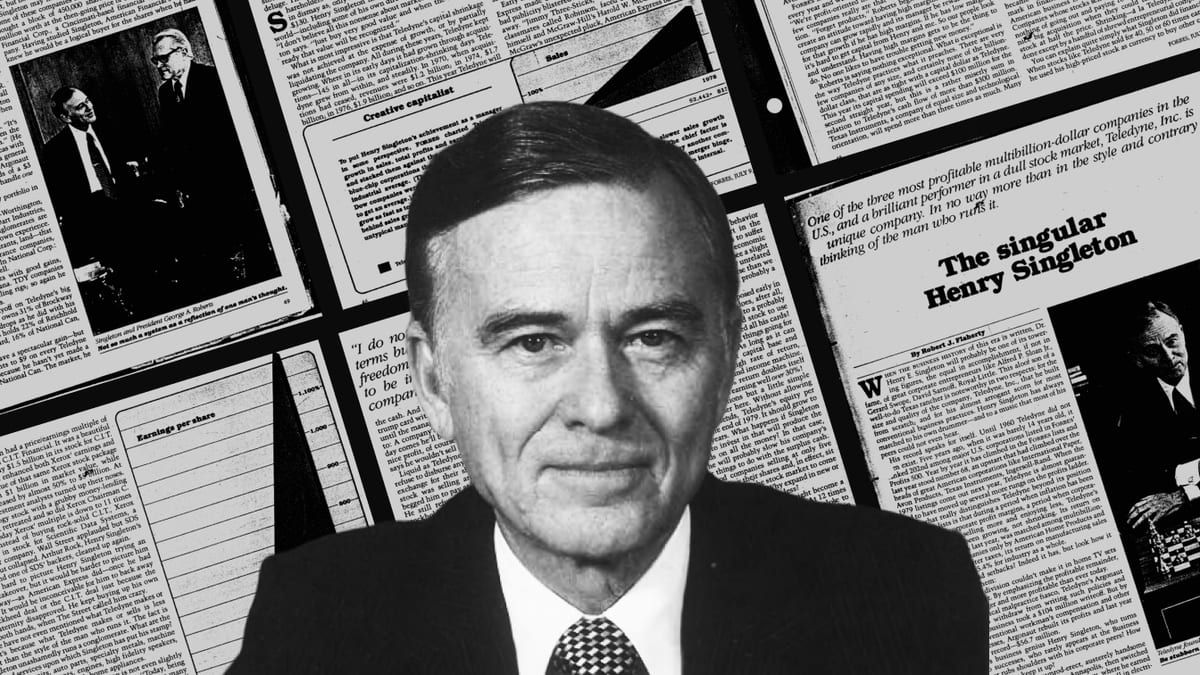
“Buy them when nobody wants them. Sell them when everybody does. The rest is just sticking to it.” Henry Singleton (paraphrased, multiple sources)
Henry Singleton is the operator most cited by other operators when they want to explain what they mean by ‘capital allocation’. He built one of the most extraordinary public-market track records in postwar American business by doing two specific things at the exact right moments. From 1961 to 1969, when Teledyne’s stock was richly valued, he used it as currency to acquire 130 small electronics and aerospace companies. From 1972 to 1984, when Teledyne’s stock was cheap, he stopped acquiring and bought back nearly 90 percent of his own shares. The total shareholder return over twenty-four years was approximately 20-fold.
Almost everything serious anyone has ever said about capital allocation since 1980 is downstream of him.
Texas to MIT
Henry Earl Singleton was born in 1916 in Haslet, Texas. He briefly attended the United States Naval Academy, then transferred to MIT, where he completed his bachelor’s, master’s, and doctoral degrees in electrical engineering. He reportedly paid part of his graduate education with chess tournament winnings; he was a strong master-level player.
His first major job was at Hughes Aircraft under Howard Hughes, where he designed missile guidance systems through the early 1950s. He moved to Litton Industries in 1957 as head of its electronic systems division. Litton was the prototype 1950s-era conglomerate, and Singleton spent three years inside watching Charles Tex Thornton roll up small defence-electronics companies. He learned both how the model worked and where it had structural weaknesses.
In 1960 he left Litton to start his own version with George Kozmetsky. They called it Teledyne.
The 130 acquisitions
The first phase of Teledyne, from 1961 to 1969, is one of the cleanest case studies of multiple arbitrage in public-market history.
Teledyne’s stock traded at a sustained premium to the market through the 1960s. The multiple averaged something near 50 times earnings during the conglomerate boom. Singleton recognised that as long as his own stock was richer than the stocks of the small electronics and aerospace companies he wanted to buy (which typically traded at 10 to 15 times earnings), every acquisition funded with Teledyne paper was accretive. He bought a target trading at 12 times earnings, paid for it with Teledyne stock trading at 50 times earnings, and the combined entity reported an immediate increase in earnings per share simply because of the multiple gap.
He did this 130 times in nine years.
He was not random about it. The acquisitions clustered in defence electronics, aerospace components, and specialty industrial businesses with strong incumbent positions in their narrow markets. Each business stayed under its own brand, its own management, and its own profit-and-loss reporting. The Teledyne head office allocated capital between them.
In 1969 he stopped. The conglomerate boom was ending, his own multiple was compressing toward the market, and the arithmetic that had made paper-funded acquisitions free money had quietly closed. Where other 1960s conglomerate builders kept acquiring out of habit and watched their stocks collapse through the 1970s, Singleton simply stopped.
The 90 percent buyback
What he did next is what most M&A history remembers him for. Between 1972 and 1984 Teledyne executed eight separate tender offers and repurchased approximately 90 percent of its own outstanding shares. The total dollar value of the buybacks was on the order of $2.5 billion. The cash came from the internal free cash flow of Teledyne’s 130 operating subsidiaries, supplemented at certain points by modest debt.
The mathematical effect on a remaining shareholder was extraordinary. If you held one Teledyne share through the entire period, your ownership percentage of the company grew tenfold without you spending any money. Every dollar of operating earnings retained by the company now belonged proportionately more to you. Teledyne’s stock price followed the underlying value capture. The shares, which had traded at roughly $15 in 1962, were trading above $300 by 1986.
The discipline behind this was unusual. Most CEOs do not stop acquiring when the multiple compresses. Most CEOs do not buy back 90 percent of their own shares. Most CEOs do not have the nerve to keep buying back when their own stock has already doubled (Singleton continued to repurchase throughout the run-up because he calculated the intrinsic value was still rising faster than the price).
The operating philosophy
The Teledyne operating model is what most serious capital allocators have studied since 1985.
The head office was tiny. Fewer than 50 people ran Teledyne at its conglomerate peak, with 130 operating subsidiaries.
Decentralisation was nearly total. Each operating subsidiary had its own management, its own books, its own brand, and effectively its own corporate culture. The head office’s job was capital allocation, not operating management.
Wall Street was a distraction. Singleton held quarterly earnings calls only when required. He almost never met with sell-side analysts. He believed managing the share price was the wrong job for a CEO.
Long-term planning was a fantasy. He said publicly, several times, that he did not believe in long-term plans. He responded opportunistically to whatever the world was doing.
Cash flow was the unit of value. Earnings, especially under tax-driven accounting choices, were an opinion. The cash that actually came in the door was the only number worth tracking.
What every capital allocator since has learned from him
The Singleton playbook is unusually clean to extract because the moves were so disciplined and the results so legible.
Issue stock when your multiple is high. Buy back stock when your multiple is low. Most CEOs do exactly the opposite, because pressure from boards and analysts is asymmetric: it is easier to defend an acquisition than a buyback, even when the buyback is the better trade.
Decentralise operations completely. The operating CEO’s job inside each subsidiary is to run that business. The corporate CEO’s job is to allocate the resulting cash flow.
Avoid empire-building. Singleton famously stopped at 130 acquisitions. He did not feel the need to be the largest conglomerate in America. He felt the need to be the most efficient one.
Stay quiet. The fewer interviews you give, the more time you have to think. The clearer your thinking, the better your capital decisions.
Hold cash when there is nothing to buy. The opportunities will come, and the operators who patiently waited will have the firepower when they do.
Buffett has cited Singleton multiple times. So has William Thorndike, whose 2012 book The Outsiders ranked Singleton first among the eight CEOs profiled, ahead of Buffett’s own stewardship of Berkshire Hathaway during the same period. The Outsiders is now standard reading for serious capital allocators.
The lesson is unflashy. Allocate the cash well. Issue stock when it is rich. Buy it back when it is cheap. Stop when there is nothing more to do. Do this for thirty years and the compounded result is unrecognisable from where you started.
Career timeline Key moments
- 1916 Born in Haslet, Texas, the son of a farmer.
- 1940 Earns BS, MS, and PhD in electrical engineering from MIT. He pays his way partly through chess tournaments.
- 1950 Joins Howard Hughes at Hughes Aircraft. Spends the early 1950s designing missile guidance systems.
- 1957 Joins Litton Industries, the original 1950s-era conglomerate, as head of its electronic systems division.
- 1960 Leaves Litton with co-founder George Kozmetsky to start Teledyne. Begins acquiring small electronics and aerospace companies using Teledyne stock.
- 1961 to 1969 Acquires 130 separate companies. Teledyne's stock trades at a sustained premium multiple (averaging 50-plus times earnings); each acquisition is funded with overvalued paper, producing accretive multiple arbitrage on every deal.
- 1969 Stops acquiring. Reads the market correctly. Teledyne's multiple is no longer high enough to justify paper-funded acquisitions.
- 1972 to 1984 Begins the most aggressive share-repurchase program in corporate history. Across eight separate tender offers, Teledyne repurchases approximately 90 percent of its outstanding shares. Singleton finances the buybacks with internal cash flow from the operating subsidiaries.
- 1986 Teledyne shares, which traded at roughly $15 in 1962, are now trading at over $300, a 20-fold return in 24 years.
- 1991 Steps down as CEO. Continues as chairman.
- 1999 Dies in Beverly Hills at 82.
- 2012 William Thorndike's book The Outsiders ranks Singleton as the most effective CEO in American postwar business history. The ranking permanently reshapes how operators study capital allocation.
In their own words Selected quotes
-
“Buy them when nobody wants them. Sell them when everybody does. The rest is just sticking to it.”
Henry Singleton, paraphrased in numerous biographies -
“I do not believe in long-term planning. I respond opportunistically as the world changes.”
Henry Singleton, quoted in Distant Force by George Roberts -
“We have always thought of stock as a financial security like any other. When the price is high relative to value, you issue it. When it is low, you buy it back.”
Henry Singleton, shareholder letter -
“The job of a chief executive is to figure out, every quarter, the best place to invest the next dollar of free cash flow. Almost nothing else matters as much.”
Henry Singleton, attributed in industry coverage
Notable and surprising Things you might not know
- He earned his BS, MS, and PhD in electrical engineering from MIT, and reportedly funded part of his graduate education through chess tournament winnings. He was a master-level player.
- He stopped acquiring companies in 1969 exactly when Teledyne's stock multiple compressed to levels that no longer justified paper-funded acquisitions. The market timing is unusually clean: the same conglomerate boom that had created the opportunity was ending.
- From 1972 to 1984 Teledyne repurchased approximately 90 percent of its outstanding shares. The total dollar value of the buybacks was roughly $2.5 billion. No major American public company has repurchased a comparable proportion of its own equity before or since.
- Teledyne's compound shareholder return from 1962 to 1986 was roughly 14 percent annually. Warren Buffett has cited Singleton several times as one of the small group of executives whose capital-allocation record he most admires.
- Singleton was famously decentralised in operations. Each of Teledyne's 130 operating subsidiaries kept its own management, its own financial reporting structure, and its own brand. The Teledyne head office had fewer than 50 employees at peak conglomerate size.
- He almost never met with Wall Street analysts and held quarterly earnings calls only when required. He believed managing the share price was a distraction from managing the business.
- William Thorndike's 2012 book The Outsiders ranked Singleton first among the eight CEOs profiled, ahead of Warren Buffett's own Berkshire stewardship. The ranking has become part of the canonical reading list of every serious capital-allocator since.
The Playbook How Henry built it
- 01 Capital allocation is the CEO's single most important responsibility. Almost no operational decision matters as much as where the next dollar of free cash flow gets deployed.
- 02 Stock is a currency. Issue it when it is overvalued (acquisitions). Buy it back when it is undervalued (repurchases). The discipline to do both is rare.
- 03 Decentralisation is not a luxury; it is the requirement that lets a single CEO run 130 unrelated businesses without losing the plot.
- 04 Empty calendars are an indicator of seriousness. The CEOs who spend more time thinking and less time meeting tend to allocate capital better.
Published May 15, 2026